The vision is to design novel electrolytes that enable batteries with extreme performance characteristics — cheaper, safer, longer-lasting, and more powerful — for grid storage, transportation decarbonization, space exploration, and defense applications.
What we’re working on
- Aqueous iron metal batteries — a new generation of low-cost energy storage based on iron chemistry that can significantly reduce energy-storage costs.
- Li- and Na-ion batteries for extreme environments — building on prior results to design batteries that survive and perform under temperature, rate, and safety conditions that current chemistries cannot meet.
Research highlights
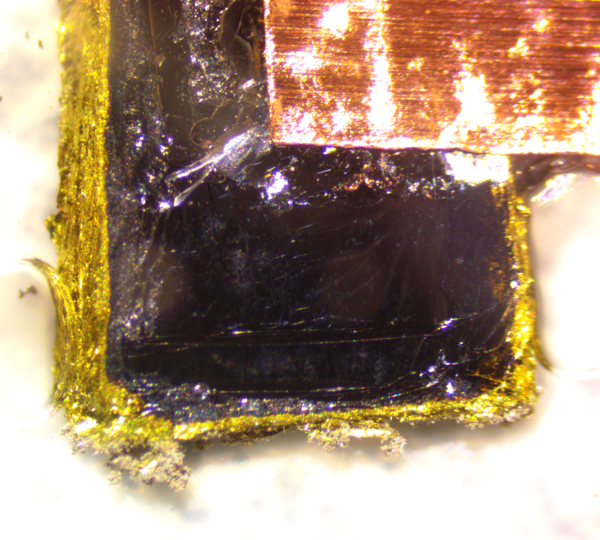
Li-plating mechanism in fast-charging Li-ion batteries
We investigate the interplay between Li intercalation and Li plating, which together govern battery safety and fast-charging performance. The work elucidates the mechanism of Li plating to guide materials innovation and electrode design that reduce plating risk and enable extreme fast charging. Read the paper in Joule →
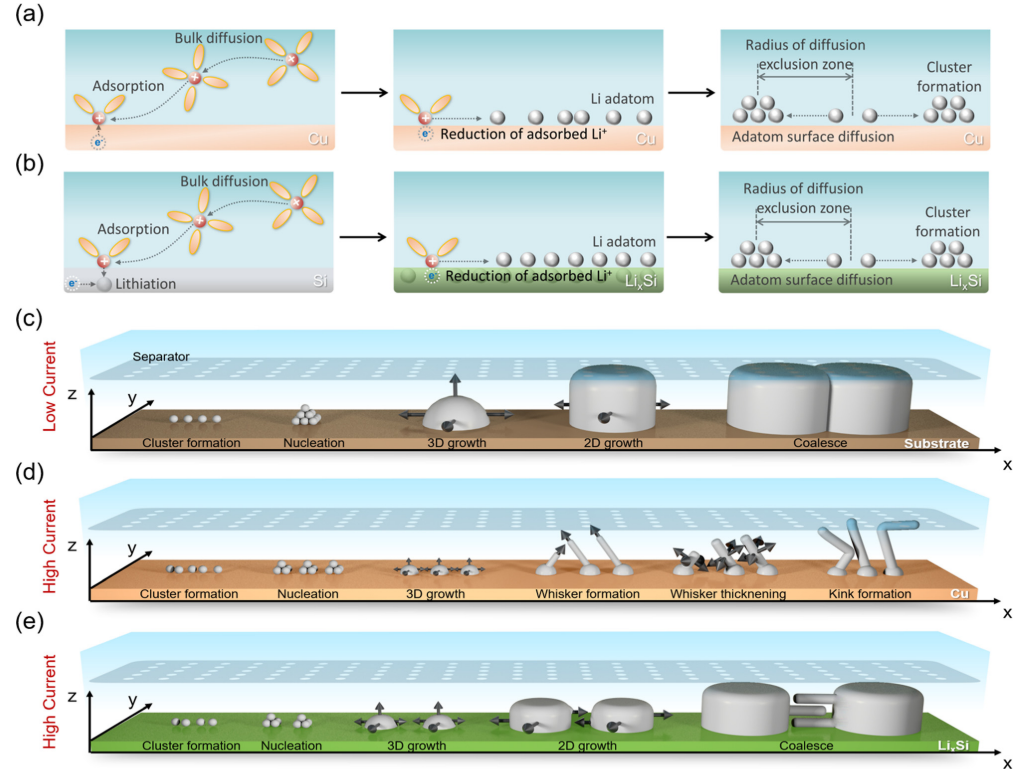
Li deposit morphology on Cu and Si substrates
Using electron microscopy, optical imaging, MD simulations, and electrochemistry, we reveal how Li deposits develop into hemispheres, dendrites, and other structures on Si and Cu substrates — directly impacting battery reversibility, internal-short risk, and overall safety. Read the paper in Energy & Environmental Science →
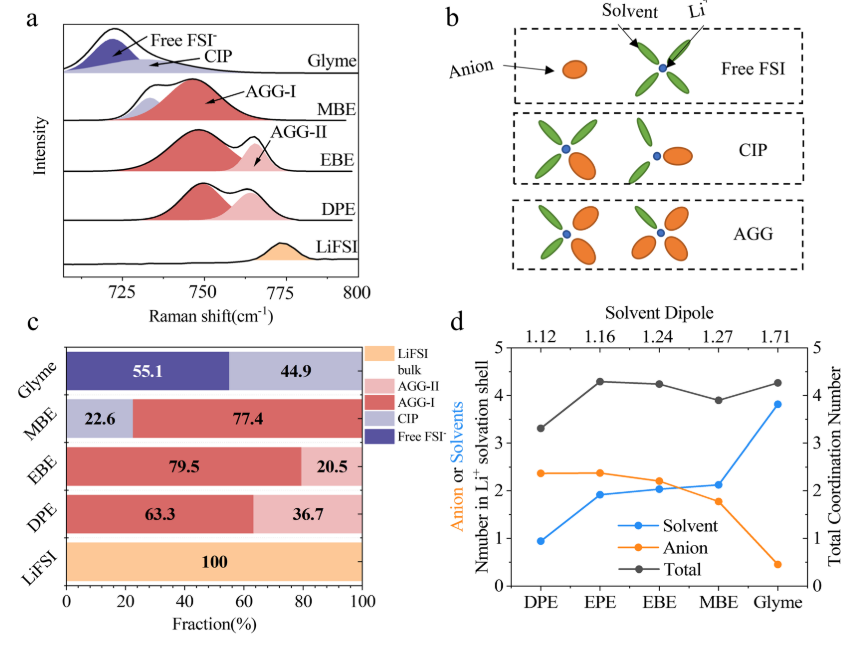
Fast-charging ether electrolytes (SOLE)
We developed single-oxygen linear ether (SOLE) electrolytes that overcome graphite compatibility issues and deliver superior fast-charging and low-temperature performance compared with commercial baselines — while maintaining reasonable polarity and low viscosity. Read the paper in Journal of Materials Chemistry A →
Iron metal batteries for renewable storage
Iron’s abundance makes it an ideal battery material. We are extending the cycle life of aqueous Fe-metal batteries by improving Fe-anode coulombic efficiency through electrolyte engineering — enabling long-lasting Fe batteries for storing renewable electricity. Read the paper in ACS Central Science →
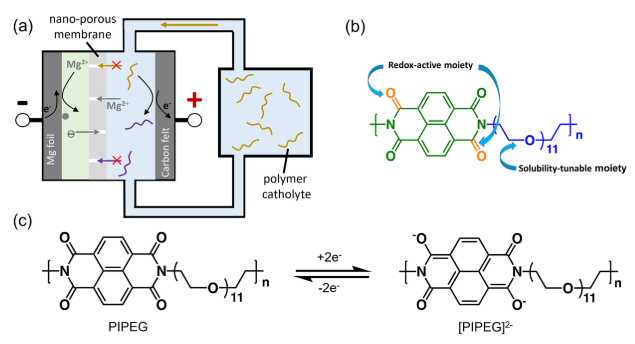
Magnesium-based redox flow batteries
Two complementary advances in Mg flow-battery chemistry: combining iodine redox with a Mg anode produced the first Mg-based redox flow battery with strong rate capability; pairing a Mg foil anode with a porous membrane and polymer-solution catholyte demonstrated the first Mg–polymer redox flow battery. Read the paper in ACS Applied Energy Materials →
Selected publications
- Science, 2015, 350(6263), 938–943 — “Water-in-salt” electrolyte enables high-voltage aqueous Li-ion chemistries.
- Nature Communications, 2017, 8, 14083 — High-power rechargeable magnesium/iodine battery chemistry.
- ACS Central Science, 2022, 8(6), 729–740 — Aqueous electrolytes reinforced by Mg and Ca for highly reversible Fe metal batteries.
- Energy & Environmental Science, 2022, 15(12), 5284–99 — Li deposition mechanism on Si and Cu in carbonate electrolytes.
- Advanced Materials, 2022, 34(23), 2202063 — Acid-in-clay electrolyte for wide-temperature proton batteries.
- Joule, 2021, 2(5), 393–414 — Interplay of Li intercalation and plating on a single graphite particle.
- Chemical Science, 2024, 15, 9224–9239 — Carboxylate ester-based electrolytes for Na-ion batteries.